


The EU Entrepreneurship Competence Framework (EntreComp): Building Skills for Future Entrepreneurs
EU4Youth Team, July 1, 2024
The Entrepreneurship Competence Framework (EntreComp), developed by the European Union, is a comprehensive guide designed to help individuals, organizations, and policymakers cultivate the entrepreneurial skills necessary for navigating the challenges of today’s economy. Established by the European Commission in 2016, EntreComp provides a common reference for developing and assessing entrepreneurship competencies in a variety of contexts, ranging from education and training to business creation and social innovation. This framework is part of the EU’s broader strategy to foster entrepreneurial mindsets, enhance employability, and stimulate economic growth across Europe.
This article delves into the EntreComp framework, exploring its key components, how it is being applied across Europe, and the real impact it has had on building entrepreneurial skills in diverse sectors.

What is the EntreComp Framework?
The EntreComp framework was launched in 2016 as part of the European Union’s commitment to fostering entrepreneurship across all sectors of society. It defines entrepreneurship broadly, not only as the creation of new businesses but also as a mindset that enables individuals to transform ideas into action, solve problems, and create social and economic value.
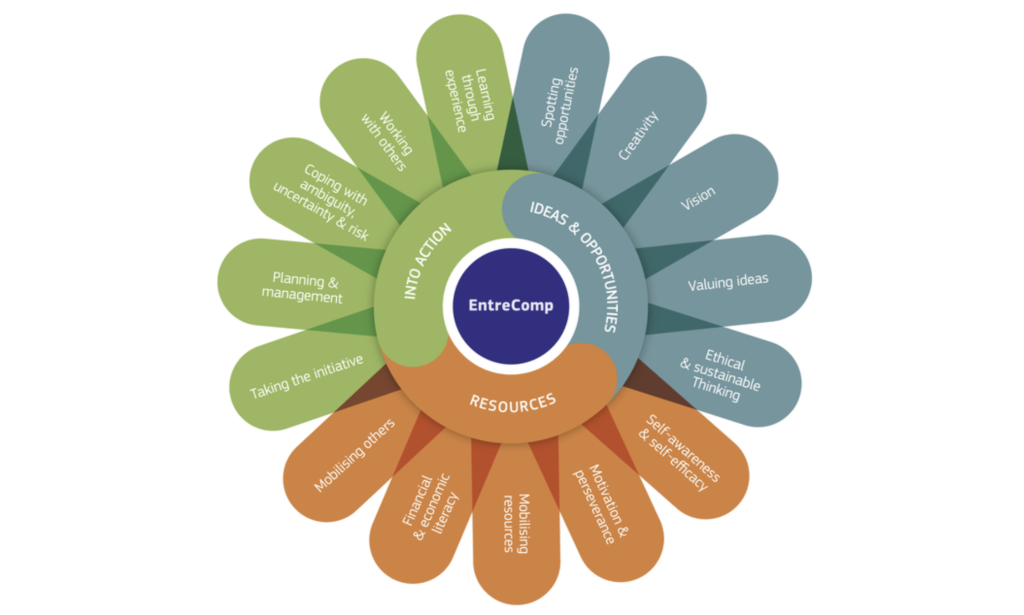
EntreComp outlines 15 competencies that are organized into three interconnected areas:
- Ideas and Opportunities: This area focuses on the ability to spot opportunities, generate creative ideas, and assess and evaluate them in terms of feasibility and impact.
- Resources: This area emphasizes the need to mobilize and manage resources effectively, including personal strengths, knowledge, and financial assets.
- Into Action: This area centers on turning ideas into action by setting goals, managing uncertainty, working with others, and achieving results.
Each of these competencies is further broken down into different levels of proficiency, making the framework adaptable for learners at all stages—from beginners to advanced entrepreneurs.
The goal of EntreComp is to help individuals develop an entrepreneurial mindset that can be applied across all walks of life, from starting a business to contributing innovatively within existing organizations. The framework is designed to be flexible, allowing educators, policymakers, businesses, and civil society organizations to tailor it to their specific needs.
Application of EntreComp Across Europe
EntreComp has been widely adopted across Europe as a foundational framework for developing entrepreneurship skills, not only in business contexts but also in education, training, and social initiatives. In particular, it has become a reference point for educators and policymakers who are looking to integrate entrepreneurship education into curricula at all levels—from primary schools to universities and vocational training programs.
A 2018 report by the Joint Research Centre of the European Commission highlighted the growing use of EntreComp in diverse settings across Europe. The report found that EntreComp had been incorporated into more than 50 education and training initiatives in EU countries, with the goal of improving entrepreneurial competencies among students, job seekers, and employees.
For instance, in Spain, EntreComp has been embedded into the curriculum of the Basque Country’s Vocational Education and Training (VET) programs. The region’s VET schools have used the framework to develop a range of learning modules that help students build entrepreneurial skills, particularly in problem-solving, teamwork, and creative thinking. In 2020, the Basque VET System reported that over 85% of its students had received training based on the EntreComp framework, and many had gone on to start their own businesses or contribute innovatively to their workplaces.
Similarly, in Finland, EntreComp has been integrated into the “StartUp Refugees” initiative, which aims to help refugees and migrants develop the entrepreneurial skills needed to succeed in Europe’s labor market. The program uses EntreComp to structure its training modules on idea generation, resource management, and business development. Since its inception, more than 500 refugees have completed the program, with many launching their own businesses or securing employment.
Impact of EntreComp in Entrepreneurship Education and Training
One of the key areas where EntreComp has had a measurable impact is in entrepreneurship education. According to a 2021 European Commission report, more than 70% of EU member states have adopted policies to integrate entrepreneurship education into their national curricula, using EntreComp as a guiding framework. This has led to a surge in the number of young people receiving entrepreneurial training at schools and universities.
In particular, Entrepreneurship Education in European Schools, a project funded by Erasmus+, has aligned its programs with the EntreComp framework. The initiative has reached over 1.5 million students across the EU, equipping them with the skills to think creatively, manage resources, and turn their ideas into action. The project has been particularly successful in fostering an entrepreneurial spirit among secondary school students, with 30% of participants indicating that they are likely to pursue entrepreneurship as a career following their education.
Moreover, EntreComp has been widely used in adult learning and lifelong education. A notable example is the “EntreComp Europe” project, a multi-country initiative that provides adult learners with entrepreneurial training through workshops, online courses, and mentoring programs. This project has reached over 10,000 adults in Belgium, Italy, the Netherlands, and Spain, helping them develop entrepreneurial competencies that can be applied in various contexts, including social enterprises, non-profits, and corporate environments.
Challenges and Opportunities in Implementing EntreComp
While EntreComp has made significant strides in fostering entrepreneurship skills across Europe, its implementation is not without challenges. One of the key issues is the need for greater awareness and understanding of the framework among educators and policymakers. A 2020 study by the European Training Foundation (ETF) found that while many educators recognize the value of entrepreneurship education, there is still a lack of training on how to effectively integrate EntreComp into teaching practices.
To address this, the European Commission has developed a range of tools and resources to support educators in using EntreComp. These include the EntreComp Playbook, which provides practical guidance on how to implement the framework in different educational settings, and the EntreComp into Action toolkit, which offers real-life examples of how the framework can be applied in entrepreneurship training.
Despite these challenges, the opportunities for scaling EntreComp across different sectors remain vast. As the demand for entrepreneurial skills grows in response to economic shifts and technological advances, EntreComp provides a flexible and comprehensive framework that can be adapted to a wide range of contexts, from traditional business environments to social innovation and community development.
The Future of EntreComp
Looking forward, the European Commission aims to expand the reach of EntreComp by encouraging its adoption in new areas such as digital entrepreneurship and green entrepreneurship. These emerging fields require a specific set of entrepreneurial skills, including digital literacy, sustainability practices, and innovation management—competencies that EntreComp is well-positioned to address.
Furthermore, the European Skills Agenda for 2025 emphasizes the need to build entrepreneurial skills as a critical component of the EU’s strategy for economic recovery and growth. EntreComp will play a central role in this agenda by helping individuals, businesses, and communities develop the competencies needed to adapt to changing market conditions and create new opportunities in a post-pandemic world.
EntreComp’s Role in Shaping the Future of Entrepreneurship
The Entrepreneurship Competence Framework (EntreComp) has proven to be a powerful tool for fostering entrepreneurial skills across Europe. Its comprehensive structure, flexibility, and adaptability have made it an essential resource for educators, policymakers, and businesses alike. By providing individuals with the competencies needed to transform ideas into action, manage resources, and create value, EntreComp is helping to build a more innovative, entrepreneurial Europe.
As the EU continues to prioritize entrepreneurship as a key driver of economic growth, the role of EntreComp will only grow in importance. Whether it is through entrepreneurship education in schools, adult learning programs, or social innovation initiatives, EntreComp is helping to unlock the potential of millions of individuals and driving the entrepreneurial mindset that is essential for the future of work.
References
- European Commission Joint Research Centre. (2018). EntreComp into Action. Retrieved from (https://publications.jrc.ec.europa.eu/repository/handle/JRC109128).
- Startup Refugees. (https://startuprefugees.com).
- EntreComp Europe Project. (https://entrecompeurope.eu).
- European Commission. European Skills Agenda. (https://ec.europa.eu/social/main.jsp?catId=1223).